Hunter S Thompson is widely known for his decadent drug use including hallucinogenics and alchohol to the point of severe addiction. He was known for his vulgar sense of humor and his style of journalism. His writings were generally centered arround his point of view, where he described the situation according to his feelings and emotions. Thom
Monday, January 26, 2009
Hunter Thompson
Who was Hunter S Thompson, and was he mentally stable?
Hunter S Thompson is widely known for his decadent drug use including hallucinogenics and alchohol to the point of severe addiction. He was known for his vulgar sense of humor and his style of journalism. His writings were generally centered arround his point of view, where he described the situation according to his feelings and emotions. Thom
pson created several different personalities and names for himself, until he claimed the lines between who he really was and who he claimed he was were blurred. "I'm never sure which one people expect me to be. Very often, they conflict - most often, as a matter of fact. ...I'm leading a normal life and right along side me there is this myth, and it is growing and mushrooming and getting more and more warped. When I get invited to, say, speak at universities, I'm not sure if they are inviting Duke or Thompson. I'm not sure who to be." It seems as though Hunter S Thomson was an accentric man, fascinated by the vulgar and absurd, who either never knew his true identity, or lost it in the fog of drug use.
Hunter S Thompson is widely known for his decadent drug use including hallucinogenics and alchohol to the point of severe addiction. He was known for his vulgar sense of humor and his style of journalism. His writings were generally centered arround his point of view, where he described the situation according to his feelings and emotions. Thom
Wednesday, January 14, 2009
Book Portfolio
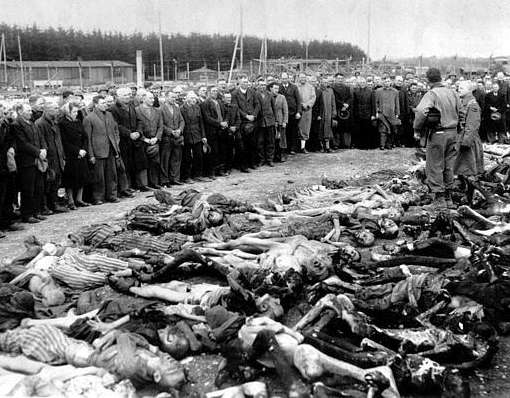
Since the generation that suffered through the Holocaust and World War Two are rapidly dwindling, it is important that we save the memories and tales of the people who actually experienced this tragedy in order that the generations to come can understand at least a tiny portion of their suffering. Bearing Witness, Stories of the Holocaust, is a collaboration of many short stories written by survivors of World War Two and were directly related to the Holocaust because of their persecution. The main theme in this collaboration of tales is to remind the people who did not experience this travesty of their suffering, and to offer an insight into what life was like for the people who were abused by Nazi Germany. It is about survival and their triumph over death.
Just because this particular collection of stories details the events of the Holocaust, it is important to understand the tales of our ancestors. It helps us understand our origins, and the rawness of human emotions in harsh times. In the
twenty first century, it is difficult to understand the extent of damage and suffering when it has happened so far away and so many years ago. To some, it may seem that if they have not been directly related to an event like this, it does not matter if they have any knowledge of it whatsoever. A massive tragedy like this should not be forgotten, out of simple respect to the humans who have suffered through it. It is not only the stories of the victims of the Holocaust that are important to World History. First hand tales of every major event are very useful in understanding what truly happened. Over the years, the truth can be forgotten or twisted, either due to rumors, lost information, or human denial to make us feel better. “The stories in this anthology give us a human face to the statistics about millions. These writers show what happened to ordinary people in many countries of Europe under the Nazis – in homes and crowded ghettos, on the transports, in the death camps, to those to died and those who survived.” – Introductions of Bearing Witness. In order to respect these people, we must learn these tales of their past, however gruesome they may be. They went through more hardship that many Americans today can ever imagine; carrying your hidden infant under your shawl, praying that your friends do not decide to turn on you and devour her, or being torn away from your mother and father to go into ‘hiding’, only to be taken away by a group of conspicuous and frightening men to be trapped inside a reeking rail car. These stories are important for all people to read and understand.
The authors perspective in
this collaboration of anecdotes is clearly viewed because of the fact that they are written in first person and describe true tales of the Holocaust. There is no one set category that all storytellers fall into; some are young Catholic boys, some are Jewish mothers, and some are grown men. There was no difference between who was victimized and who was left alone, only their religions and beliefs. All or most these tales are told from within prisons and death camps of Europe. An American during World War Two would not have been able to understand the suffering of these people unless they were enlisted in the army and had the opportunity to be one of the liberators of the enslaved. Jews in Europe were in constant fear of their lives. Although religious discrimination is happening constantly all over the world at some level, a tragedy like this had never happened before in American History. The Holocaust was a unique situation. The period of time that it occurred in probably did not change the circumstances much; if a tyrannical leader came to power in present day, American would probably react much the same as they did in the 1940’s. The true nature of human beings does not change in such a small amount of time as 70 years. Evil men still exist, just as persecution and torture still exist.
People who are fortunate enough to live in a safe country should at least understand the stories of those who have suffered through the Holocaust. It is easy to take for granted all that you have, and to read anecdotes of extreme suffering is able to change one’s perspective. We need to ensure the truth of the matter, and respect these people and their stories. Friday, January 9, 2009
LBJ - Wilderness Act
Before the Wilderness Act of 1964, there was no real definition of 'wilderness' on American soil. There also was no law preventing all United States territory to be settled and built upon. This would mean that if enough humans existed on America soil, that every last frontier could be conquered, and there would be no reminder of what the 16th century transcendentalists wrote thier poems about, or no fragment of our American History according to the participants of the Oregan Trail, or Western natives's previous home. Although some terrain would be virtually impossible to inhabit, such as the Rocky Moutains or the unforgiving moutains of Alaska. However, if there were no law to protect these places in complete purity they would eventually become poluted in one way or anther. There are currently 9.1 million acres of proclaimed wilderness in the United States. The Wilderness Act was said to promote '...an area where the earth and its community of life are untrammeled by man, where man himself is a visitor who does not remain.'
The Wilderness Act is a good thing not only for American People but for the rest of the world. It preserves many, many species that exist only in the North American region, and possibly even creatures that reside only in America. If most American soil was inhabited many indigenous creatures would be forced out of thier home, resulting in their deaths and maybe even the demise of thier species. This would disrupt the food web throughout North America. Another plus is that there would be specified limit to the amount of woods and forrest we are allowed to harvest. The vast woods of North America contribute to the global imput of oxygen and the health of the ozone. Also, a large portion of our American history would be lost with the population of the wilderness. The virgin land of the Pilgrim's America would be gone forever. Just seeing pictures of the untamned West helps us understand the inestimable hardship our ancestors had to overcome. The wilderness is in essence the basis of our country.
Subscribe to:
Comments (Atom)